Friday, May 9, 2014
Rube Goldberg Reflection
Our task was to create a Rube Goldberg device to trigger something as simple as opening a book, making a coffee, or even just turning on a light. Our idea for our Rube Goldberg device was to have it turn the page in a book, using 15 steps. We started by drawing our design, and then we started building it. We started with dominoes as our first step, triggered by a swinging pendulum. The dominoes then went on to knock a marble out of its track, which went down a slide, knocking a weight off the table. this weight was then supposed to trigger a series of events which eventually ended with a piece of string pulling the page over.
We were unable to actually finish our Rube Goldberg because of the fact that other classes and groups kept taking parts from our project making it impossible to make any progress. Our group worked pretty well together. We all participated, and helped each other through every step in the project. I liked the idea of the project and I wouldn't mind doing something like it again in the future.

Friday, April 11, 2014
Rube Goldberg and Simple machines
Journal Entry: Energy Transfer and Simple Machine Learning

|
Inclined
Plane
A
plane is a flat surface. For example, a smooth board is a plane. Now, if the
plane is lying flat on the ground, it isn't likely to help you do work.
However, when that plane is inclined, or slanted, it can help you move
objects across distances. And, that's work! A common inclined plane is a
ramp. Lifting a heavy box onto a loading dock is much easier if you slide the
box up a ramp--a simple machine.
|
|
 |
Wedge
Instead
of using the smooth side of the inclined plane, you can also use the pointed
edges to do other kinds of work. For example, you can use the edge to push
things apart. Then, the inclined plane is a wedge. So, a wedge is actually a
kind of inclined plane. An axe blade is a wedge. Think of the edge of the
blade. It's the edge of a smooth slanted surface. That's a wedge!
|
 |
Screw
Now,
take an inclined plane and wrap it around a cylinder. Its sharp edge becomes
another simple tool: the screw. Put a metal screw beside a ramp and it's kind
of hard to see the similarities, but the screw is actually just another kind
of inclined plane. to help you visualize. How does the screw help
you do work? Every turn of a metal screw helps you move a piece of metal
through a wooden space. And, that's how we build things!
|
 |
Lever
Try
pulling a really stubborn weed out of the ground. You know, a deep,
persistent weed that seems to have taken over your flowerbed. Using just your
bare hands, it might be difficult or even painful. With a tool, like a hand
shovel, however, you should win the battle. Any tool that pries something
loose is a lever. A lever is an arm that "pivots" (or turns)
against a "fulcrum" (or point). Think of the claw end of a hammer
that you use to pry nails loose. It's a lever. It's a curved arm that rests
against a point on a surface. As you rotate the curved arm, it pries the nail
loose from the surface. And that's hard work!
|
 |
Wheel
and Axle
The
rotation of the lever against a point pries objects loose. That rotation
motion can also do other kinds of work. Another kind of lever, the wheel and
axle, moves objects across distances. The wheel, the round end, turns the
axle, the cylindrical post, causing movement. On a wagon, for example, the
bucket rests on top of the axle. As the wheel rotates the axle, the wagon
moves. Now, place your pet dog in the bucket, and you can easily move him
around the yard. On a truck, for example, the cargo hold rests on top of
several axles. As the wheels rotate the axles, the truck moves.
|
 |
Pulley
Instead
of an axle, the wheel could also rotate a rope or cord. This variation of the
wheel and axle is the pulley. In a pulley, a cord wraps around a wheel. As
the wheel rotates, the cord moves in either direction. Now, attach a hook to
the cord, and you can use the wheel's rotation to raise and lower objects. On
a flagpole, for example, a rope is attached to a pulley. On the rope, there
are usually two hooks. The cord rotates around the pulley and lowers the
hooks where you can attach the flag. Then, rotate the cord and the flag
raises high on the pole.
|

Friday, March 28, 2014
Newtons laws Assessment
1. What are the relationships between forces and motion?
Force is the amount of pressure applied. motion is a movement.
Ex: Swinging a hammer is an example of force. Hitting a nail is an example of motion.
2. What are the variables that affect motion and force?
Initial speed, acceleration, and friction are the variables that affect motion and force.
3. How does Newton’s three laws describe the motion of a moving
object?
objects in motion stay in motion unless some force is applied. The objects weight, acceleration, and the force applied affect the force and motion.
4. How does gravity impact objects?
it can effect the speed, velocity, and direction in which the object moves.
Force is the amount of pressure applied. motion is a movement.
Ex: Swinging a hammer is an example of force. Hitting a nail is an example of motion.
2. What are the variables that affect motion and force?
Initial speed, acceleration, and friction are the variables that affect motion and force.
3. How does Newton’s three laws describe the motion of a moving
object?
objects in motion stay in motion unless some force is applied. The objects weight, acceleration, and the force applied affect the force and motion.
4. How does gravity impact objects?
it can effect the speed, velocity, and direction in which the object moves.
Friday, January 10, 2014
Chemistry of Life

The chemistry of life is important to us because our bodies depend on certain things in order to survive. Proteins, lipids, carbohydrates, oxygen, carbon, hydrogen and nitrogen are necessary for our bodies in order for them to function properly.
Friday, December 6, 2013
chemical reactions
We placed steel wool over a bunson burner, and as a result it slowly deteriorated. The steel wool turned a blueish color.
We placed a nail in copper chloride and it turned a reddish brown color, because it stripped the ions.
We placed a nail in copper chloride and it turned a reddish brown color, because it stripped the ions.
Friday, October 25, 2013
Flame lab explanation
The flame test is used to determine the identity of an unknown metal or metalloid based on the color the salt changes the flame of the bunsen burner. The heat from the flame excites the ions and makes it change colors. The light spectra can be used to determine the identity of some elements.
Monday, October 7, 2013
video reflection
At first in the video he was talking about how things in the universe start off really complex and get more simple as time goes on. He then went on to talk about how all matter in space was created 16 billion years ago. This is known as the Big bang theory. Immediatly after the big bang happened particles were cooled and formed, creating subatomic particle clouds that formed stars and galaxies.
Friday, September 20, 2013
Oreo Cookie Lab
Oreo Cookie Lab
Author: Kenny Carnes, Pentucket HS.
Date: Lab conducted on sept.12,2013
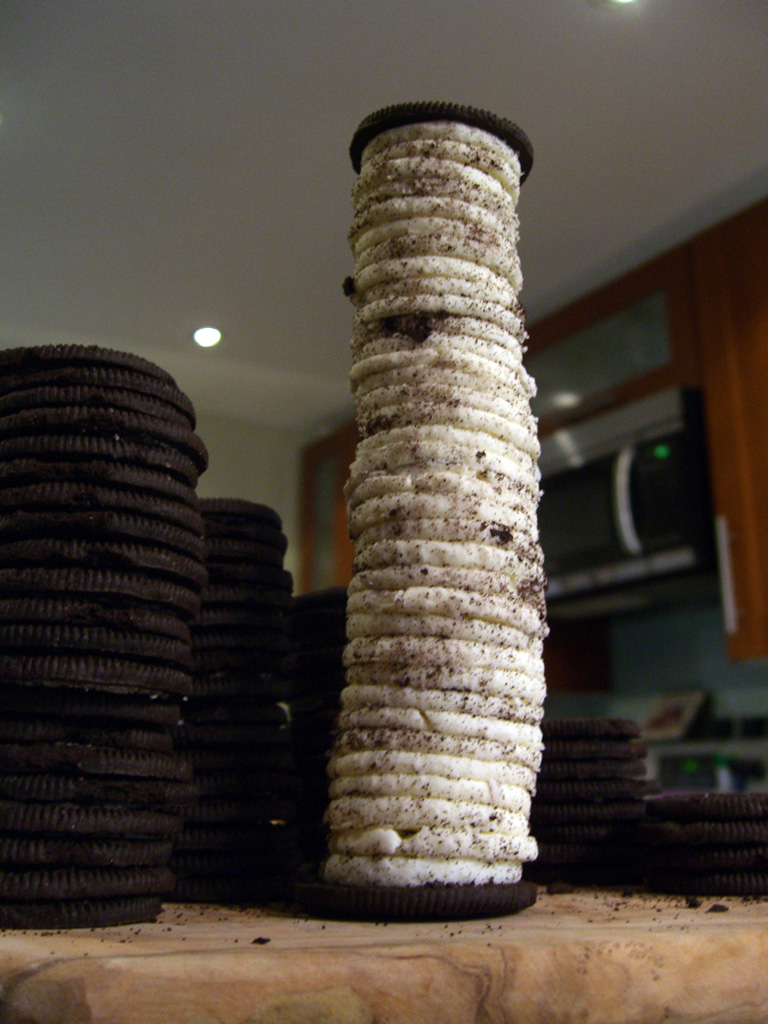
Students measured the filling in three types of Oreo cookies to determine if the filling amounts matched the advertising.
Hypothesis: I thought the filling would match the advertising.
Method:
1. Remove filling from all of the different Oreo cookies.
2. Weigh each cookie filling to determine the mass.
3. Compare masses to see if the filling sizes match the advertising.
Results:
Original Stuf: 2.85g Original/Original = 1.00%
Double Stuf: 6.33g Double/Original = 2.22%
Mega Stuf: 8.90g Mega/Original = 3.12%


Conclusion:
The results prove that every filling was accurate or close to being the exact size that the advertising claimed they were.
Author: Kenny Carnes, Pentucket HS.
Date: Lab conducted on sept.12,2013
Students measured the filling in three types of Oreo cookies to determine if the filling amounts matched the advertising.
Hypothesis: I thought the filling would match the advertising.
Method:
1. Remove filling from all of the different Oreo cookies.
2. Weigh each cookie filling to determine the mass.
3. Compare masses to see if the filling sizes match the advertising.
Results:
Original Stuf: 2.85g Original/Original = 1.00%
Double Stuf: 6.33g Double/Original = 2.22%
Mega Stuf: 8.90g Mega/Original = 3.12%

Conclusion:
The results prove that every filling was accurate or close to being the exact size that the advertising claimed they were.
Friday, September 13, 2013
Learning this week
a. Do Bowling Balls float or Sink:
I learned that an object will only float in water if the density of that object is less than the density of water. I also gained valuable skills in measuring because we had to measure and figure out the density. We also had to figure out the volume and mass of the bowling balls. We then had to convert pounds to grams using a metric conversion.
To fully understand buoyancy we first had to figure out all of these things. Once we figured out the mass, density, and volume we had a general idea on whether the bowling ball would sink, float, or be stuck in the middle. We then Hypothesized on whether the ball would float or sink. We then tested this theory and found out what the end result would be. The heaviest ball sunk. The medium weight ball sunk, but hovered on the bottom. The lightest ball kind of floated a few inches from the bottom of the tank, and stayed there.
Friday, September 6, 2013
Why Study Science
I hope to gain a lot of knowledge on physical science. I hope to get better at chemistry, and learn some physics in the process. Also I wanted to take this course because Ms. McCarron is my favorite teacher, and I always have fun in her classes.
Subscribe to:
Posts (Atom)